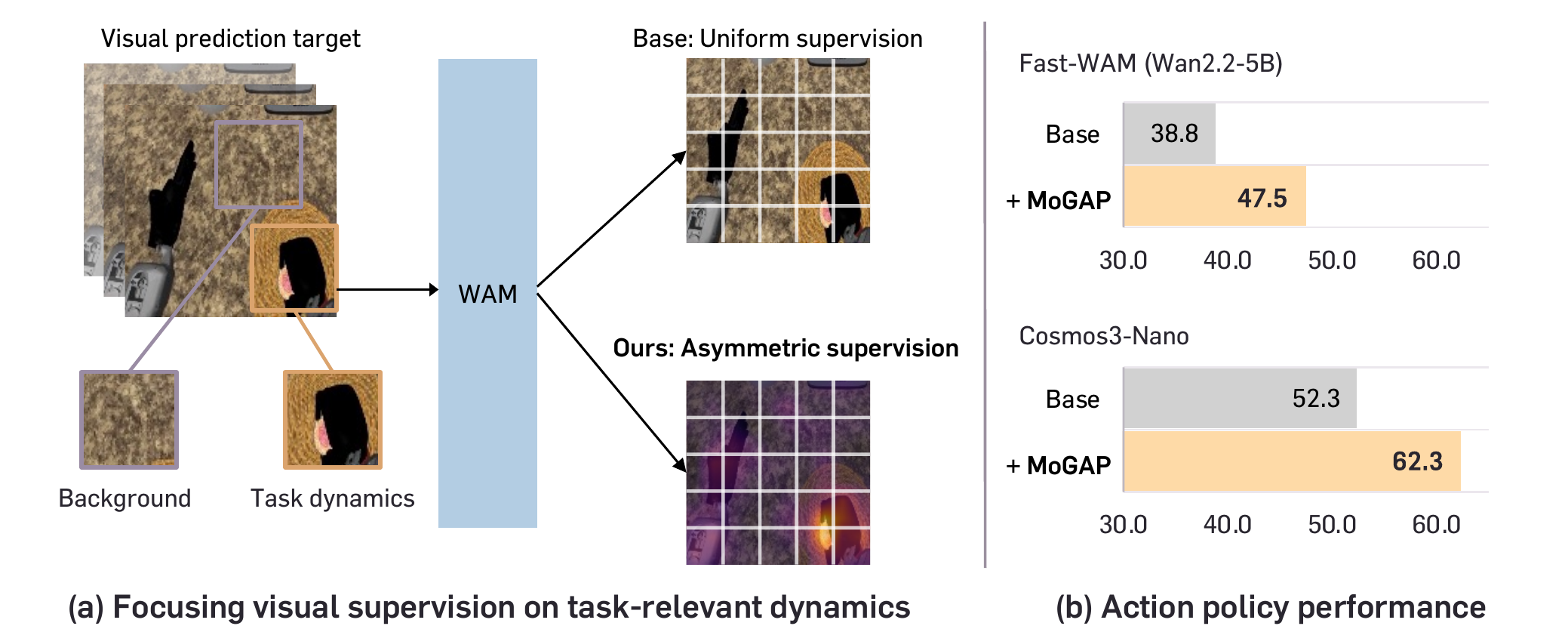
Motivation: not all regions matter equally for control
Dynamic regions capture robot motion and object interactions, while static regions often hold visually complex but control-irrelevant details such as tabletop textures. Simply reallocating a fixed visual supervision budget toward dynamic regions already improves policy performance (Fast-WAM 38.8% → 41.8%, Cosmos3 52.3% → 57.7% on GR-1 Tabletop). MoGAP turns this insight into a dedicated prediction task, yielding substantially larger gains.
Method
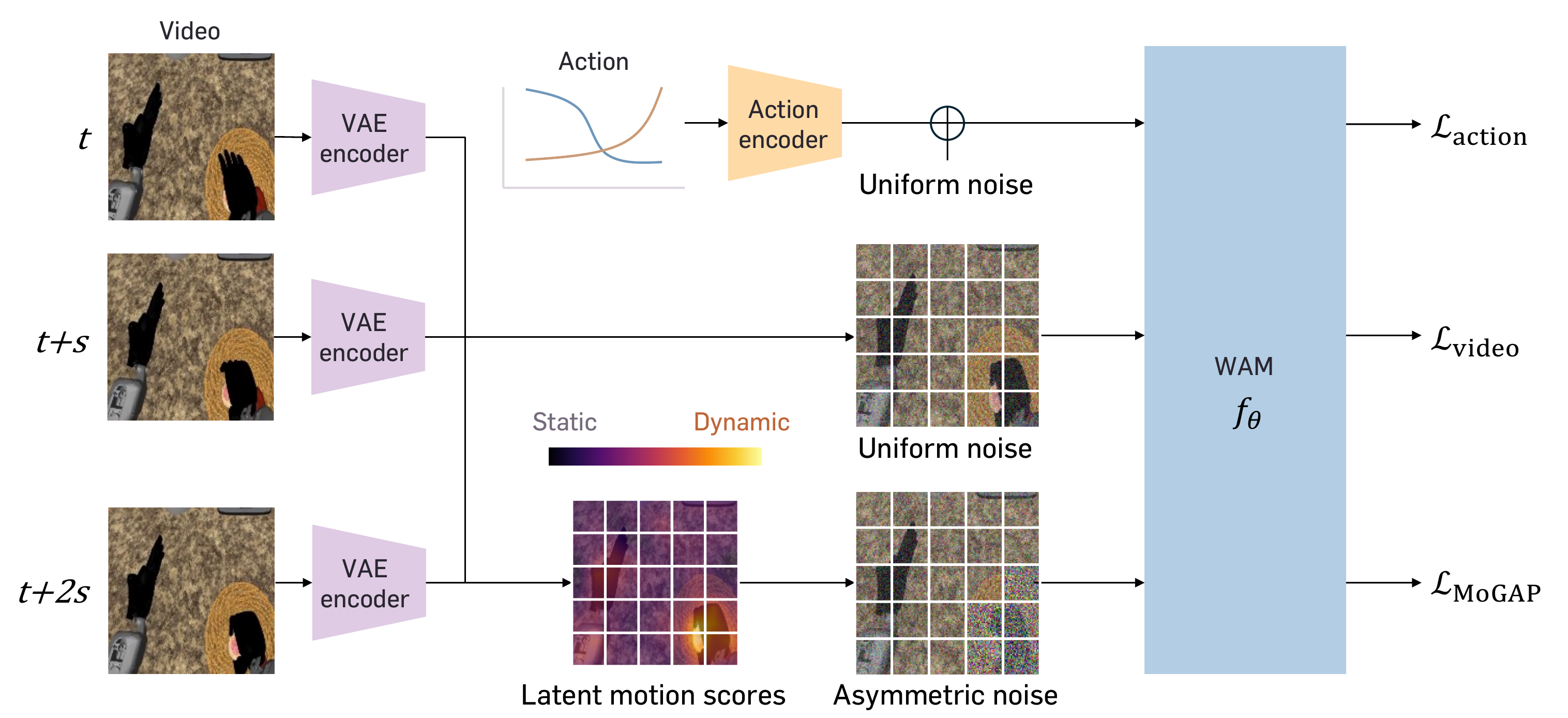
Motion-Guided Asymmetric Prediction (MoGAP) treats dynamic regions as prediction targets and static regions as scene context. It is built from three key components:
- Latent motion scores — computed from temporal differences between video latents already available during training, requiring no optical-flow estimator or external teacher.
- Asymmetric noise allocation — dynamic regions receive higher noise levels while static regions stay less corrupted, so the model must infer dynamic content from the remaining scene context.
- Training-only auxiliary path — MoGAP tokens are processed in the shared video diffusion backbone with an asymmetric attention mask, adding no parameters and omitted at inference.
Results
Real-robot manipulation
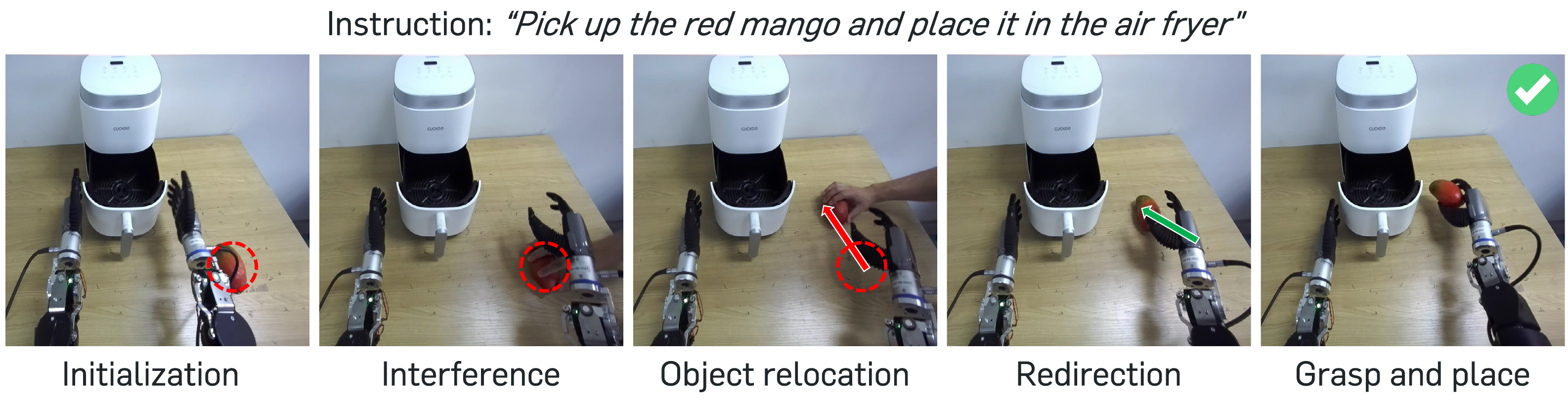
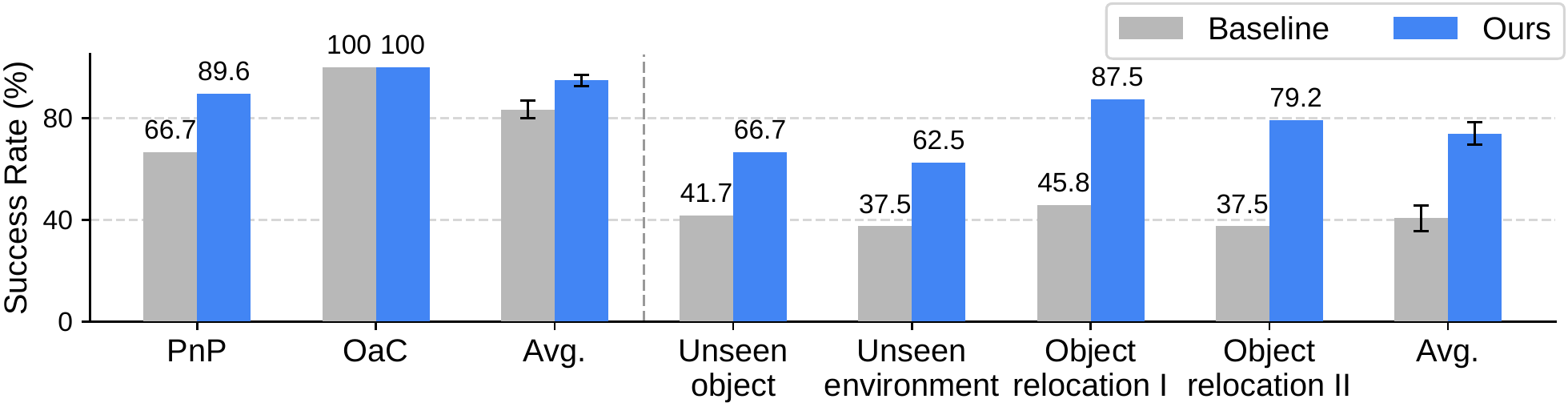
On an OpenArm humanoid with two five-finger Inspire hands, MoGAP improves over the baseline across all task groups, with the largest gains on out-of-domain tasks (average 40.6% → 74.0%). When the target object is relocated during execution, the baseline keeps reaching for the old location, whereas MoGAP redirects toward the moved object (45.8% → 87.5%), even though no relocation demonstrations were seen during training.
Simulation benchmark
On RoboCasa GR-1 Tabletop (24 humanoid manipulation tasks), MoGAP lifts Cosmos3 from 52.3% to 62.3%, surpassing all compared VLA and WAM methods, and lifts Fast-WAM (Wan2.2-5B) from 38.8% to 47.5%.
| Method | PnP | Articulated | Avg. |
|---|---|---|---|
| VLA-based methods | |||
| GR00T-N1.6 | 55.4 | 24.2 | 47.6 |
| StarVLA-α | 58.4 | 54.0 | 57.3 |
| RLDX-1 | 59.0 | 57.7 | 58.7 |
| WAM-based methods | |||
| Fast-WAM | 33.8 | 53.7 | 38.8 |
| DiT4DiT | 50.9 | 50.3 | 50.8 |
| Cosmos3 | 48.3 | 64.3 | 52.3 |
| MoGAP (Ours) | 60.8 | 66.7 | 62.3 |
Comparison with state-of-the-art VLAs and WAMs (success rate, %).
| Method (on Cosmos3) | Teacher | Avg. |
|---|---|---|
| Baseline | – | 52.3 |
| Geometry Forcing | VGGT | 53.9 |
| AGRA | DINOv2 | 55.4 |
| TSA | VideoMAEv2 | 56.8 |
| VideoREPA | VideoMAEv2 | 57.8 |
| VideoREPA | V-JEPA2.1-L | 59.2 |
| MoGAP (Ours) | – | 62.3 |
Comparison to teacher-based supervision (success rate, %).
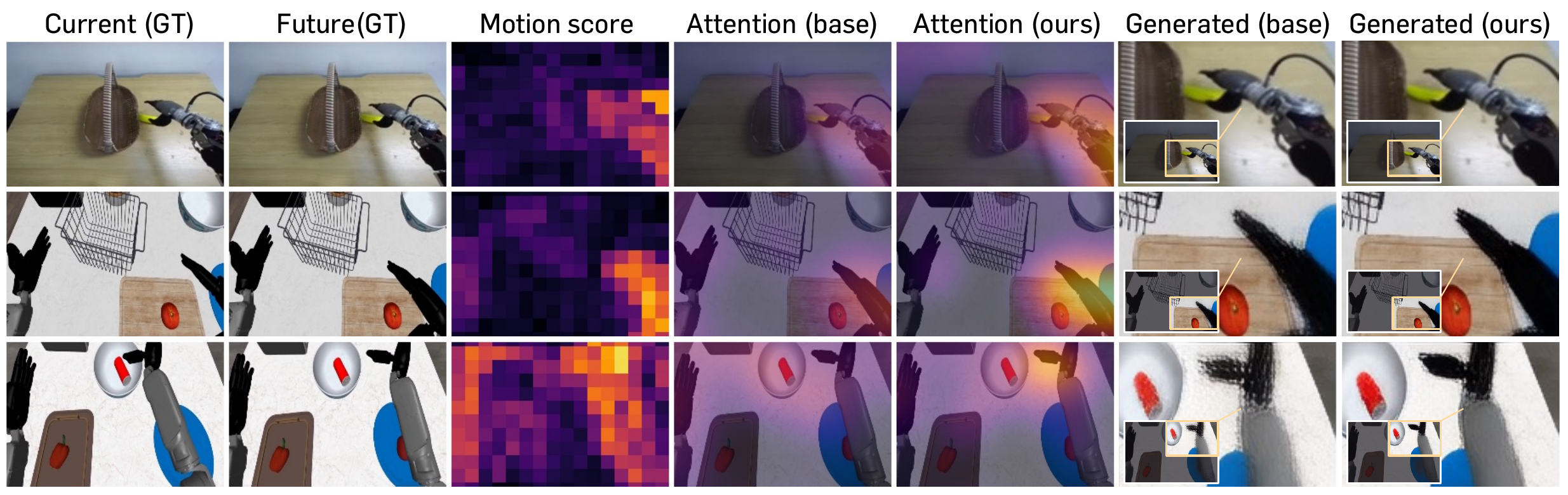
What MoGAP learns
Latent motion scores localize subtle arm, hand, and object motion. After training with MoGAP, the action tokens attend more strongly to the moving hand and manipulated object, and generated future frames preserve the moving arm more clearly instead of blurring it.